



Thailand tours
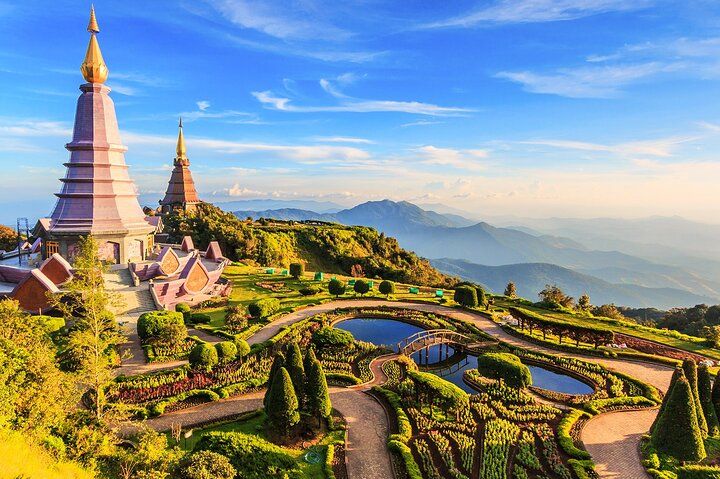
Thailand is a land of endless beauty and wonder, renowned for its lush jungles, majestic gold-spired Buddhist temples, famous beaches, bustling cities, delectable cuisine, and numerous festivals throughout the year. Known as the “Land of Smiles”, Thailand is renowned for its welcoming and friendly people.
On your visit to Thailand, you’ll have the opportunity to explore historic sites, including ancient ruins and exquisite structures with unique designs. From the serene beauty of its majestic temples to the bustling energy of its cities, Thailand offers something for everyone. Whether you’re interested in exploring the country’s rich cultural heritage or simply soaking up the sun on its stunning beaches, you’re sure to have an unforgettable experience.
So why wait? Book your trip to Thailand today and be prepared to be amazed by its beauty, serenity, and mystery. You won’t regret it!


Passport & Visa
Ordinary travelers from the following nations that have bilateral agreements with Thailand are eligible for the visa-exemption program for stays of up to 45 days or 90 days, based on their homeland:
45 days visa-exemption
- Cambodia
- Myanmar (International Airports only)
- Hong Kong
- Lao
- Macau
- Mongolia
- Russia (VoA)
- Vietnam
90 days visa-exemption
- Argentina
- Brazil
- Chile
- The Republic of Korea
- Peru
Currency
Thailand's currency, the Baht (THB), is differentiable into 100 satangs.
Currency exchange services are extremely simple to find in Thailand. There are exchange offices everywhere as well as every bank in the nation. Also, there are currency exchange services available at airports, which are open around-the-clock.
There are many ATMs, making it simple to use them to withdraw money anytime and anywhere you desire.
In Thailand, big enterprises, hotels, and eateries all accept credit and debit cards. But, you might discover that smaller shops and cafés don't accept cards or, in the alternate scenario, that anti-fraud software has stopped your card; as a result, these unforeseen events undoubtedly cause severe trouble while traveling.
Foreign exchange charges. For each transaction you make, you can be charged up to 3%. For every $4,000 spent in Thailand, there is a levy of $120.
costs for currency exchange. You will be charged a Dynamic Currency Conversion fee if you use US dollars to make an ATM withdrawal or pay a vendor (DCC). DCC may come with higher fees and low exchange rates.
Weather
The cool season, which lasts from November to February and is when travel to Thailand is at its busiest, is when the climate is the coolest and driest.
Bangkok (in the south-central region of Thailand) experiences temperatures ranging from 18 to 32 degrees Celsius during the cold season, whereas the morning and evening temperatures in northern and northeastern Thailand are often cooler.
March through June are considered the warmer months.
Bangkok's current average temperature is 34°C, however it may get as hot as 40°C at its highest. Now is the time to celebrate the beginning of the monsoon season with events like Songkran and the Rocket Festival.
Avoiding April might be the wisest course of action because it appears to be the hottest month nationwide.
The majority of the nation's rainfall occurs during the rainy season, which lasts from July through October. At this time of year, the days are extremely cloudy and muggy, with only six hours or so of sunshine per day.
Vaccinations & Medicines
To acquire any necessary shots or medications, check the list of medications and vaccines and schedule a visit to the doctor at least one month prior to your trip.
Regular vaccinations: Before every trip, check to make sure you are current on all regular immunizations. These vaccines include, among others:
- Chickenpox (Varicella)
- Diphtheria-Tetanus-Pertussis
- Flu (influenza)
- Measles-Mumps-Rubella (MMR)
- Polio
- Shingles
A current COVID-19 vaccination record is required for all qualified travelers. For further details, please check Your COVID-19 Vaccination and see in this link below: Thailand Vaccines & Medicine
Phone & Internet Service
To contact Thailand, dial 00 + 66 (the country code) + the correspondent's phone number (without the 0).
The websites of Thailand's three mobile operators, True, Ais, and Dtac, are available in English. At the ports of sale for the mobile companies, 7 Eleven supermarkets, Family Mart, or even the airport, SIM cards cost about 100 baht.
In Thailand, there is good access to the internet. You can connect to wifi practically anywhere with a smartphone (airports, restaurants, hotels, bars, guest house).
Flights & Airports
The majority of International and domestic airports located near to the tourism hub namely Bangkok, Chiangmai, Phuket, Surat Thani, etc. The superstructure and infrastructure are well-managed by the authorities to maintain the professional and convenient standards to welcome and make a positive impression to both international and regional travelers.
There are some common international and domestic airports attracting a large number of visitors in Thailand.
- Suvarnabhumi International Airport
- Phuket International Airport
- Don Mueang International Airport
- Pattaya International Airport
- Samui Airport
- Krabi Airport
- Surat Thani International Airport
- Chiang Mai International Airport
- Hat Yai International Airport
- Chiang Rai International Airport
Security
Thailand is generally a safe place to visit. Compared to other emerging nations, physical attacks and other crimes tend to occur far less frequently here. Nonetheless, due to ongoing political unrest and periodic mass demonstrations in Bangkok and other parts of the nation, you must exercise extreme caution.
Be advised that uploading pictures of people wearing indecent clothes or drinking alcohol to social media sites can lead to fines and/or jail time for both the uploader and the people in the pictures.
Thieves and bag stealers should be avoided at all costs, especially when riding a motorcycle or in an open vehicle like a tuk tuk. Assure the safe storage and concealment of valuables. Items have been snatched from bags as passengers were dozing off on buses and trains.
Drugs and alcohol use can make you less conscious of your surroundings, less in control, and less vigilant, which can result in attacks, robberies, accidents, and misplaced travel documents. Know your limit if you drink. Foreign bars frequently serve stronger drinks than those found in the UK.
Language
Thailand's official language is Thai, commonly spoken all across the country. Moreover, Thais citizens are also fluent in English, ếpcially in Bangkok and other popular tourist destinations. Since many Europeans as well as other Asians travel to Thailand, Thai individuals frequently speak other Asian and European languages to various levels.
Although learning the Thai language is difficult, Thai people are willing to teach visitors a few words so they can communicate.
- Hello – Sawadee khrup/ka
- How are you? – Sa bai dee mai khrup/ka
- Goodbye! – La gorn khrup/ka
- Thank you – khop khun (khrup/ka)
- Sorry/excuse me – Khor thoad khrup/ka
- Where is the restroom– Hong nam yoo tee nai khrup/ka?
Time difference
Currently, local time in Bangkok is 6 hours ahead of London
Electricity
The power is provided at 230V in Thailand. If the appliance has a single voltage rating, it must operate at 230V, which is the country's standard supply voltage. If not, it ought to be utilized in conjunction with an inverter or converter to enable the appliance to function effectively and safely.
On-site traffic
- Aircraft: Over 20 airports in Thailand are served by a number of airlines. Low-cost airlines frequently run specials, and rates are relatively reasonable. You should check Bangkok's two airports if your flight is departing or arriving at Suvarnabhumi or Don Muang.
- Train: For extended journeys, it is a practical and comfortable mode of transportation (especially from Bangkok to Chiang Mai). There are three types of classes, and we frequently pick the second, ventilated or air conditioned.
- Bus: Such an affordable mode of transportation is widely used and can travel anywhere, even to locations where trains do not go. Although the bus is a little quicker and less expensive than the train, it is not suggested for lengthy journeys.
- A good way to get around cities is via tuk tuk. You can take pleasure in the breeze and avoid the sun. Also, you can bargain the cost before you take the journey, though it's not significantly less expensive than taxis.
- Taxis: Taxis are widely available, especially in major cities and popular tourist destinations. With the exception of tourist hubs in the South, the pricing is not particularly high (like Koh Samui). Go to another taxi if the one you're in doesn't have a meter or the driver won't put one in.
- The automobile is a preferred mode of transportation in Thailand. To get around, you can hire a car with your driver. But if you want to drive it yourself, you'll need a valid driver's license.
- Motorcycle: In some places, particularly the northern and island regions, motorcycles are very common. Keep in mind that both the driver and the guest must wear helmets.
- Boat: Thailand is a nation of stunning islands. You have a number of options, including a long-tail ferry, a night boat, a shuttle, and a shuttle
Useful addresses
Embassy of France in Thailand
35 Charoenkrung soi 36, Bangrak, Bangkok
Tel: [66] (0) 26 57 51 00 / (0) 26 27 21 00
Embassy of Belgium in Thailand
16 / F Sathorn Square - 98 North Sathorn Road - Silom Sub-District, Bangrak District, Bangkok
Tel .: +66 2 108 18 00
Outside opening hours and only in case of emergency: +66 81 833 99 87
Fax: +66 2 108 18 07 (Consular Section) / + 66 2 108 18 08 (Political Section)
Embassy of Canada in Thailand
15th Floor, Abdulrahim Square, 990 Rama IV Street, Bangrak, Bangkok
Such. : +66 (0) 2646-4300 - Fax: +66 (0) 2646-4336
Embassy of Switzerland in Thailand
35 North Wireless Road, PO Box 821, Bangkok
Such. : (+66) 2 674 69 00 - Fax: (+66) 2 674 69 01
